
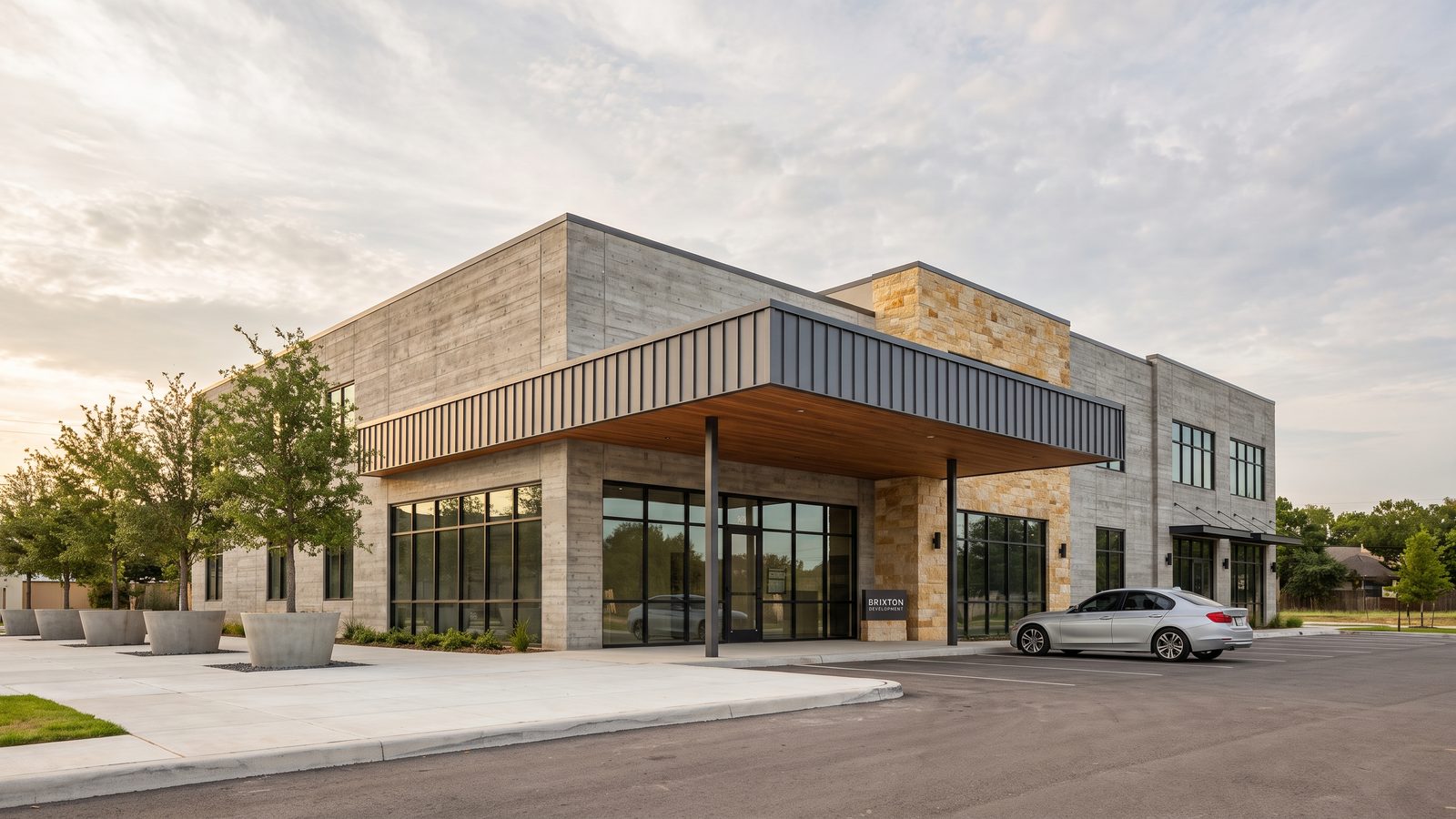
Most of the calls we get about commercial work fall into one of two buckets. Someone leasing a retail or office space wants the inside finished out before they can open. Someone else owns a lot and wants to put up a small office, retail or flex building on it. Different projects, but the same two things trip people up every time: the permit timeline, and a state accessibility rule most first-time commercial owners have never heard of.
The rule nobody mentions until it's a problem
Any commercial construction project in Texas with a total estimated cost of $50,000 or more has to be registered with the Texas Department of Licensing and Regulation under the Architectural Barriers Act. Once it's registered, a full set of construction documents goes to a Registered Accessibility Specialist for review under Texas Administrative Code Rule 68.50, on top of whatever the city or county already requires. The filing fee is $175, and missing the registration brings a $300 late fee. Projects under $50,000 don't have to register, but the space still has to meet the Texas Accessibility Standards, and a local building official can require registration anyway even on a smaller job. This applies to new construction and to a tenant build-out, not just ground-up buildings, and it's the single most common thing we see catch people off guard on a first commercial project.
Houston's own permit adds its own clock
Inside the City of Houston, a tenant build-out runs through the Houston Permitting Center's Buildout Permit. It's built for finishing out existing, empty commercial space, carries a standard 15 business-day plan review window, and the permit has to be posted on site until final inspection, with a 6-month validity period to get the work done. Depending on scope, the submittal can include architectural, structural, mechanical, electrical, plumbing, sprinkler and fire alarm drawings, and the review can route through the Fire Marshal, Planning or Health department depending on what's going into the space. A ground-up building outside city limits goes through Montgomery, Harris or Liberty County instead, on that county's own schedule.
Why timing actually matters right now
Retail and industrial space in the Houston area are both tight. Lee & Associates' second-quarter 2026 market report puts retail vacancy at 5.4 percent with average asking rents at a record $21.84 per square foot, and industrial vacancy at 7.0 percent with 27.6 million square feet still under construction. Office is a different story, with vacancy running closer to 20 to 24 percent depending on which firm's report you read, so there's more room to negotiate there than in retail or industrial. If your business needs retail or warehouse space, available inventory is thinner than it has been, which makes the permit clock on a build-out matter more. A 15 business-day plan review plus two or three correction cycles is a real chunk of the time before you can open.
How we take this on
We already permit and pass inspection with the City of Houston and with Montgomery, Harris and Liberty County on residential work, and we run commercial projects and tenant build-outs the same way: one team handling the TDLR registration, the plan review, the trades and the inspections, instead of a patchwork of subcontractors each handling their own piece. See what we take on at commercial construction, or the full list of work at services. If you have a space to finish out or a lot to build on, tell us about the project and we'll tell you straight whether the timeline and the scope fit what you need.
Sources: Texas Department of Licensing and Regulation, Elimination of Architectural Barriers program, Texas Government Code Chapter 469 and 16 Texas Administrative Code Rule 68.50 (tdlr.texas.gov); City of Houston Permitting Center, Buildout Permit HPWCODE1148 (houstonpermittingcenter.org); Lee & Associates, 2026 Q2 Houston Market Reports, Office, Industrial and Retail (lee-associates.com).