
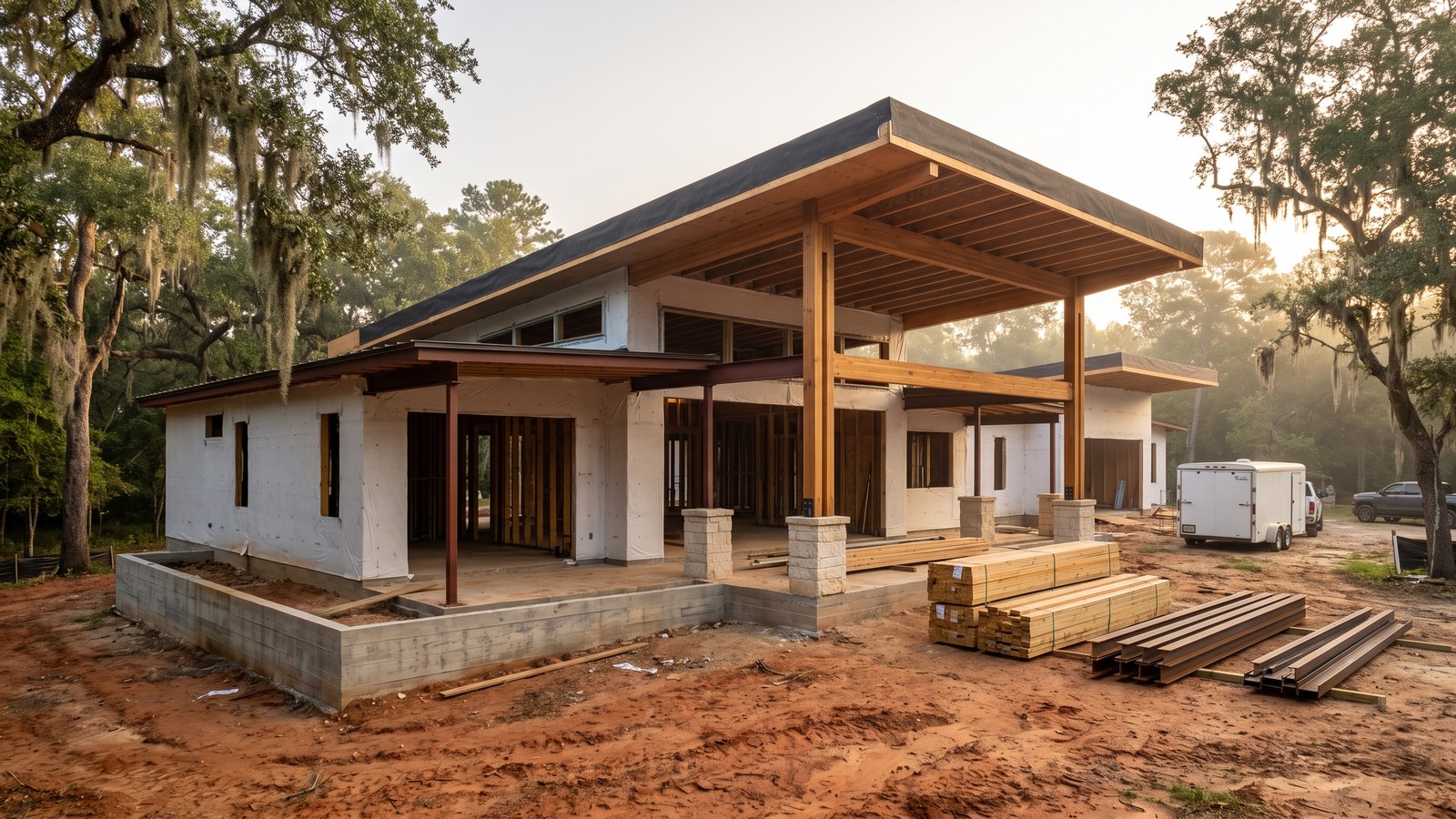
The question we hear on almost every first call is some version of how long this is actually going to take. The honest answer isn't one number. It depends on where you are in the process, which county your lot sits in, and how fast you lock plans and selections. Here's what the real data says, and where the timeline actually gets decided.
What the national numbers say
The Census Bureau tracks every permitted single-family home built in the country, and NAHB's economists publish the averages each year. For 2025, the average home took 8.8 months from permit to completion: about 1.4 months for authorization and the rest, 7.4 months, for construction. That's down from 9.1 months in 2024, the first real improvement in a few years as material supply chains settled out.
Where you land in that average depends on a few things. Homes between 1,200 and 3,999 square feet took about 9 months. Homes built for sale by a production builder moved fastest, around 7.4 months permit to completion. Owner-built custom homes took the longest at 14.3 months, and the South, which includes Texas, finished fastest of any region at 7.6 months. None of that counts the months before a permit even gets pulled: design, selections and financing.
The part that actually varies here: the permit
Most of what Brixton builds sits outside a city limit, in unincorporated Harris, Montgomery or Liberty County. That matters because each county runs its own permitting, and the three are not close to the same process.
Harris County: Kingwood, Humble, Atascocita
Unincorporated Harris County runs permits through its online ePermits system: property information, the application form, supporting documentation, then review and a final acknowledgment. The county's Permits Office is at 10555 Northwest Freeway, Suite 120, in Houston, (713) 274-3900, and is the number to call for where a specific submittal stands.
Montgomery County: Porter, Conroe, New Caney, Splendora
Montgomery County works differently. Outside a MUD or a platted subdivision with its own requirements, the county doesn't run a structural plan review on a single-family home at all. What it issues instead is a Development Permit, covering floodplain compliance, the OSSF septic permit, driveway and culvert work, and subdivision compliance. The Environmental Health Permitting Division, (936) 539-7836, is who to call to confirm what your lot needs before you count on a date.
Liberty County: Dayton, Cleveland
Liberty County's Permits and Inspections office, at 624 Fannin Street in Liberty, (936) 336-4560, requires proof of an approved, operating septic system before it will issue a building permit on most lots outside a floodplain. In a floodplain, add an elevation certificate; in a floodway, a no-rise certificate too. None of that is unusual for rural Texas county land, but it's work that has to happen before the permit, not during construction.
What actually moves your date
On our own jobs we tell clients to plan on 3 to 8 weeks for financing and permits combined once plans are final, and 6 to 12 months for construction, depending on size and how early selections are locked. The biggest schedule risk we see isn't the build itself. It's a buyer who hasn't settled on a septic design, a driveway culvert, or a lender before the lot is already under contract. Every week spent sorting that out after the fact is a week added before groundbreaking, not a week lost on-site.
If you want a written schedule against your actual lot instead of a general range, tell us about your property and your plans and we'll walk you through it. Our full process, phase by phase, is laid out on the how we build page, and more of the timing and permit questions we get are answered on our FAQ page.
Sources: National Association of Home Builders, Eye on Housing, "Single-Family Home Construction Time Declines in 2025" (September 2026), analyzing U.S. Census Bureau Survey of Construction data; Harris County ePermits and Office of the County Engineer; Montgomery County Environmental Health Permitting Division; Liberty County Permits and Inspections Office.