
New single-family homes in the US shrank to a median of 2,150 square feet in 2024, the smallest they have been in fifteen years, and held near 2,155 square feet in 2025. That is down from 2,300 square feet as recently as 2022. Smaller footprints, smaller lots, and yet the same research that tracked the drop shows buyers have not given up on personalization. They are just more particular about where the money goes.
We hear the same thing on the phone every week. Fewer people ask for the biggest house they can afford. More people ask which choices actually matter.
What "custom" actually means
A production builder sells a floor plan from a catalog with a short list of options: a few exterior colors, a couple of countertop tiers, a handful of cabinet styles. It is a legitimate way to build a house, and it is usually faster and cheaper, generally 15 to 30 percent less than a comparable custom build, because the builder buys materials in bulk and repeats the same plan across a whole subdivision.
A custom build starts from a blank sheet. The lot, the floor plan, the roofline, the room sizes, every material and fixture are choices you make, not choices picked from a list someone else built. That is also why it takes longer and costs more up front. You are buying decisions, not a discount, and that tradeoff is worth being honest about before you start.
What people actually prioritize once the house is smaller
The same national buyer survey that tracked the shrinking square footage also ranks which features people call essential or desirable, and the list has barely moved in years. A walk-in pantry and a table space for everyday eating both rate at 80 percent. A double sink in the kitchen is 78 percent. Drinking water filtration is 75 percent. Pull-out shelving and a center island tie at 74 percent. In the primary bath, a separate shower and tub is 78 percent, a linen closet is 76 percent, and a private toilet compartment is 70 percent.
None of that is exotic. It is storage, workflow and privacy. On a smaller footprint you cannot fit everything, so the choices you make about which of these to prioritize do more work than they used to.
Selections that move value more than square footage does
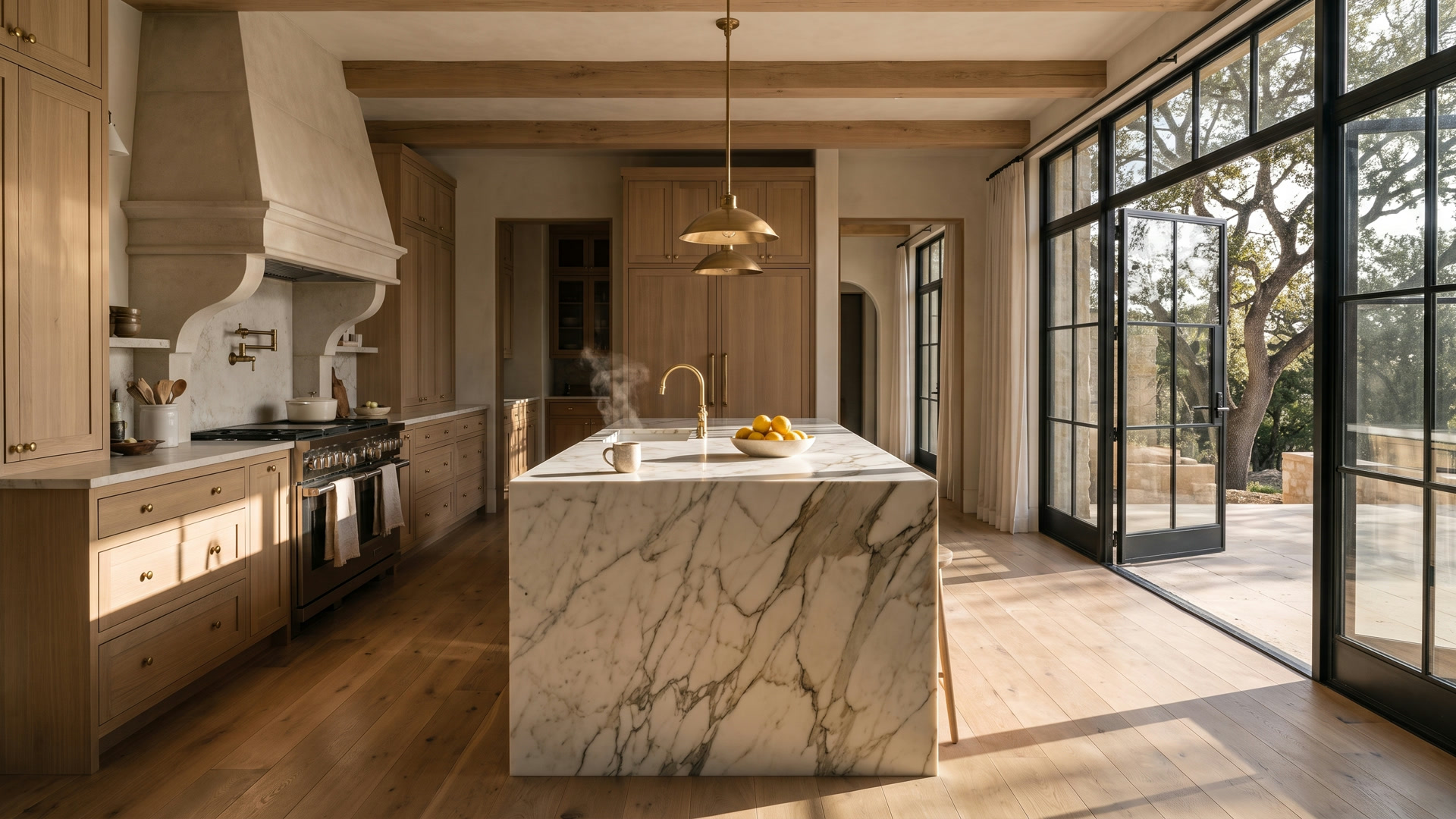
On the builds we walk people through, the choices that hold up best over time are rarely the ones that show up first in a showroom. A walk-in pantry sized for real groceries instead of a coat closet with shelves. A primary suite with its own bath and closet, not shared with anything else, on the main floor if the lot allows it. Windows and doors sized right for the room instead of oversized for effect. A laundry room placed where you actually do laundry, not wherever was left over. Energy-efficient windows and a right-sized HVAC system, because that is a bill you pay every month for as long as you own the house, not a one-time cost.
None of those are the most expensive line on the selections sheet. A full stone exterior or a designer tile package matters to how the house feels. It is not usually what decides whether the house works for how you actually live in it.
How this plays out on a real build
When we sit down with a client on a set of custom home plans, the selections process is where the real budget conversation happens, not before it. We walk the kitchen, the primary suite, and the laundry and mechanical rooms line by line and talk through what each choice costs and what it buys you, before anything is ordered. That is different from picking from three preset packages, and it is a real reason people choose to build custom instead of buying something already finished. See how each phase works on our process page, or the cost guide for how these choices show up in a real budget.
If you are working through your own list of must-haves, send us your plans and we will go through which choices are worth the money on your lot and your budget.
Source: National Association of Home Builders, "What Home Buyers Really Want" (2024 edition, nahb.org) and "Affordability Headwinds Driving Home Buyers' Interest in Smaller, More Personalized Homes in 2025" (nahb.org, February 2025).